

When you open an invitation to a wedding, birthday party, or formal dinner, you will almost always find the letters RSVP printed near the bottom. Simply put, RSVP stands for the French phrase “Répondez s’il vous plaît,” which translates directly to “Please reply.” When a host includes RSVP on an invitation, they are asking you to confirm whether or not you will attend their event.
Whether you receive a traditional card in the mail, an email invitation, or a casual text message, an RSVP requires a response. It is not just a polite request—it is essential information that helps the host plan seating, food, drinks, and venue space.
Are you trying to figure out how to handle your invitation right now?
What exactly does the French phrase mean in plain English?
Do you need to reply if you cannot attend, or only if you are coming?
What does the phrase “RSVP Regrets Only” mean?
How should you word your response so you sound polite?
Below is a step-by-step breakdown of what RSVP means, how to handle different types of invitations, and exact response examples you can copy and use immediately.
What Does RSVP Stand For?
The acronym RSVP comes from the French expression “Répondez s’il vous plaît” (pronounced ray-pon-day seel voo play).
While the words are French, the acronym has been adopted globally into English and many other languages. In modern usage, it serves as a direct request for a response from the invited guest.
Literal French Translation vs. Modern English Meaning
To understand the difference between the word-for-word translation and how we use it today, consider this breakdown:
| Aspect | Details |
| French Phrase | Répondez s’il vous plaît |
| Literal Translation | “Respond if it pleases you” |
| Modern English Meaning | “Please reply to confirm your attendance” |
| Guest Action Required | Send a clear “Yes, I will attend” or “No, I cannot attend” before the deadline. |
In standard English etiquette, “RSVP” is often used both as a noun (“Please send your RSVP by Friday”) and as a verb (“Don’t forget to RSVP to the party”). Regardless of how it is phrased, the underlying message remains the same: the host needs a headcount.
What Does “RSVP Regrets Only” Mean?
If you see the phrase “RSVP, Regrets Only” on an invitation, the response rule changes slightly:
-
If you ARE attending: You do not need to reply or contact the host. Your silence tells the host that you will be there.
-
If you CANNOT attend: You must notify the host before the specified date to inform them of your absence.
Hosts use “Regrets Only” primarily for larger, more casual gatherings (such as school birthday parties, open houses, or large company picnics) where managing individual confirmations from dozens or hundreds of people would be overwhelming.
How to Respond to an RSVP (With Exact Wording Examples)
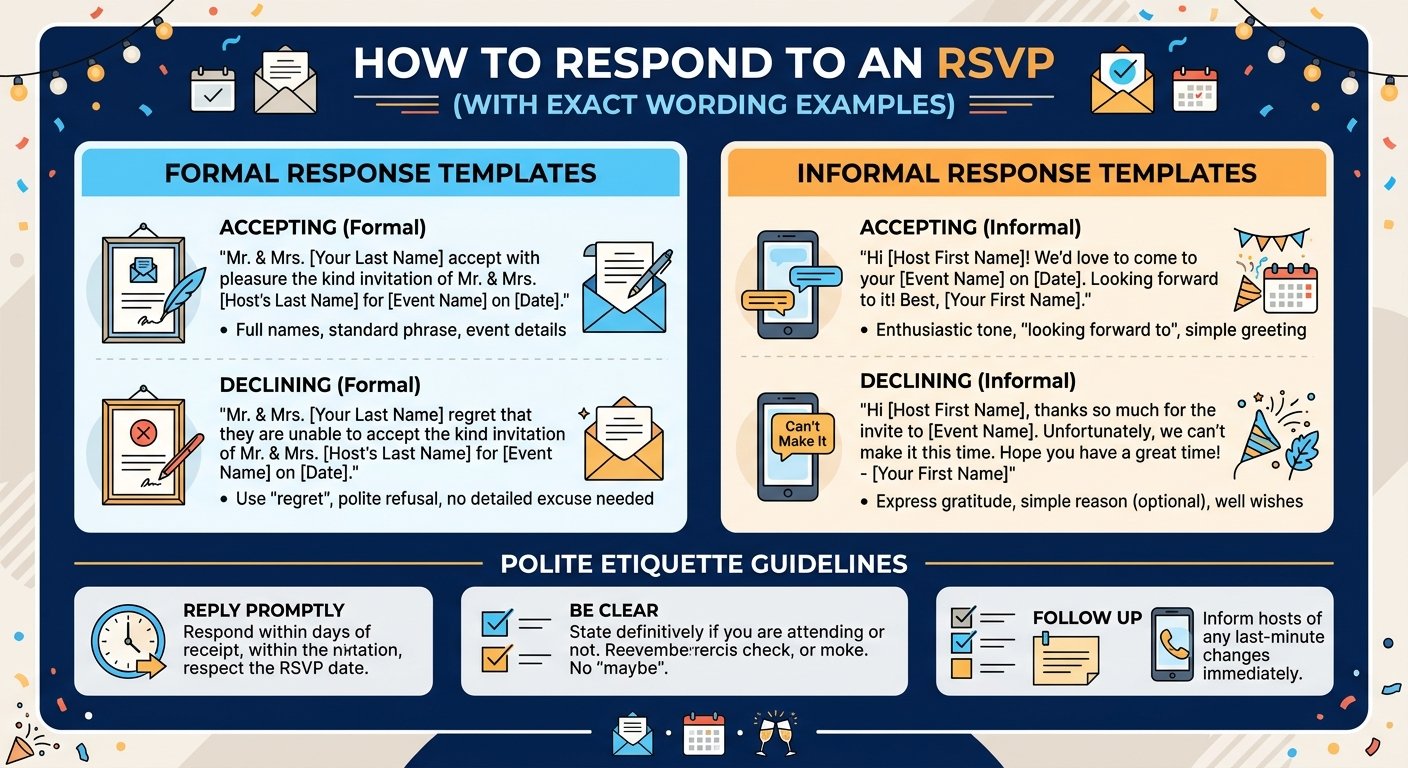
Responding to an invitation should be prompt, clear, and courteous. How you reply depends on the method requested by the host—whether it is a pre-printed response card, a digital form, an email, or a simple text message.
Here are exact response templates you can use depending on your situation:
1. Accepting an Invitation (Formal & Informal)
When you are attending, state clearly who is coming and convey your excitement.
-
Formal (Mail Card or Formal Email):
“Mr. and Mrs. Smith accept with pleasure the kind invitation of [Host Name] for [Event Date].”
-
Casual (Text or Informal Email):
“Thanks for the invite, [Host Name]! I’d love to come to [Event]. Count me in!”
2. Declining an Invitation Politely
If you cannot make it, state your refusal politely without over-explaining or giving lengthy excuses.
-
Formal (Mail Card or Formal Email):
“Mr. John Doe regrets that he is unable to accept the kind invitation of [Host Name] for [Event Date] due to a prior engagement.”
-
Casual (Text or Informal Email):
“Thank you so much for thinking of me! Unfortunately, I won’t be able to make it to [Event] on [Date]. Hope you all have a wonderful time!”
Essential RSVP Etiquette Rules You Should Know
Knowing what RSVP means is only half the process; following proper social etiquette ensures you remain a thoughtful guest and helps the host plan smoothly.
Here are the essential rules to follow:
-
Reply Before the Deadline: Hosts usually set a deadline (e.g., “RSVP by May 15th”) so they can finalize headcount for catering and seating. Always respond on or before this date.
-
Do Not Bring Uninvited Guests: Unless your invitation explicitly specifies “and Guest” or lists your family members by name, the invitation is meant only for you.
-
Be Specific About Dietary Needs: If the RSVP card includes a section for dietary restrictions, list true allergies or dietary requirements clearly so the caterer can accommodate you.
-
Stick to Your Answer: Once you confirm your attendance, changing your mind last minute creates financial waste and seating complications for the host. Only alter your response in case of a genuine emergency.
What to Do If You Miss the RSVP Deadline
If the deadline passes and you forgot to reply, do not ignore the invitation out of embarrassment.
-
Contact the Host Immediately: Reach out directly via call or text as soon as you realize the oversight.
-
Apologize Briefly: Keep it simple: “I’m so sorry for the delay in getting back to you!”
-
Provide a Definite Answer: Let them know immediately whether you can make it.
-
Offer an Easy Way Out: Let the host know that if headcount arrangements are already locked in, you completely understand if they cannot accommodate you late.
Frequently Asked Questions About RSVP
What happens if you do not RSVP?
If you do not RSVP, the host is left unsure of your attendance. This creates awkwardness because they may not have enough food or seating if you show up unexpectedly, or they may pay for a meal that goes to waste if you do not appear.
Does RSVP mean “Reply if you are coming”?
RSVP means you should reply in both scenarios—whether you are attending or unable to make it. The only exception is when the invitation specifically states “RSVP, Regrets Only.”
Is it rude to RSVP late?
Yes, responding after the stated deadline is considered poor etiquette. Event hosts rely on accurate guest counts to finalize bookings with caterers and venues, often paying per head well in advance.
Can you change your RSVP from yes to no?
You should only change a “Yes” to a “No” in the case of illness, family emergencies, or unexpected unavoidable conflict. If you must cancel, notify the host directly as early as possible with a polite apology.
Final Takeaway: Why Replying Promptly Matters
At its core, RSVP is simply a request for mutual respect between a host and their guest. By understanding that “Répondez s’il vous plaît” means “Please reply,” you help the event organizer manage budgets, seating, and food without unnecessary stress.
Whenever you receive an invitation, make it a habit to check your schedule, decide promptly, and send a clear “Yes” or “No” before the deadline.