
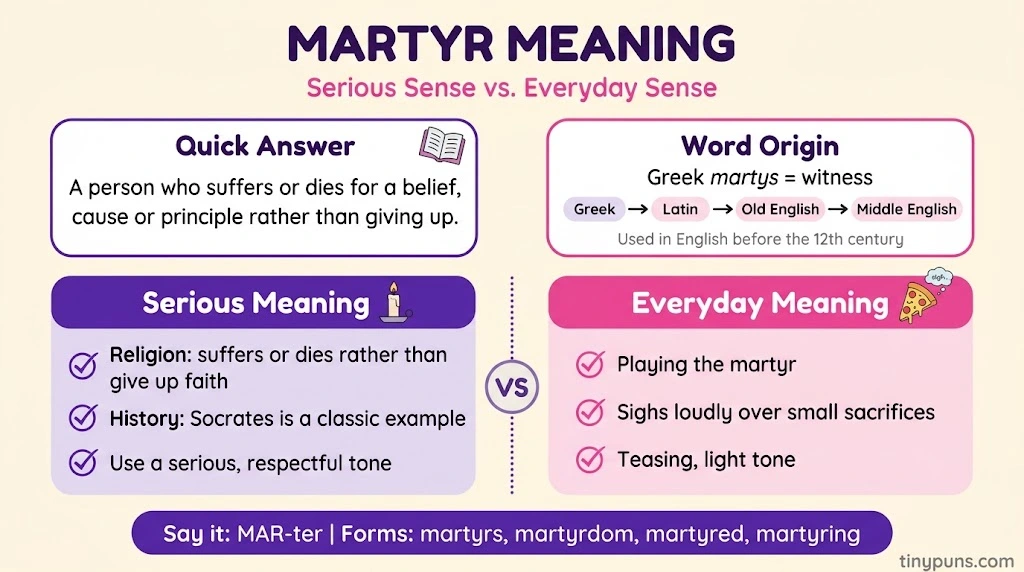
A martyr is someone who suffers or dies for a belief, cause or principle rather than giving up. It comes from the Greek word martys which means “witness. In common usage, the martyr meaning can also refer to a person who exaggerates their afflictions to elicit sympathy or attention.
There you have it in a nutshell – the martyr definition. However, the word has a life beyond its own. It may be quite serious in a history book, and mildly humorous in a family group chat. This guide includes both, so no matter where you find it, you will know how to read it, and how to use it.
Want to see other words that cause confusion? Niche meaning slang helps to decipher words that people see in online forums that everyone is wondering about. If you enjoy decoding numbers as well, the 555 meaning page explains how a number acquired its tale.
What is the Martyr Meaning?
There are two principal meanings of martyr today.
Meaning #1: The serious one. A martyr is a person who suffers or perishes for their beliefs, principles or cause. This is the earliest sense and the one you encounter in the realm of religion and history.
Meaning 2: The commonplace one. A martyr who is one who takes great pride in their sacrifice, usually for a trivial matter. Consider the individual who declares, “But I’ll carry all six bags, don’t worry, I will,” with a loud “ahghhh.”
Both meanings carry with it the concept of surrendering, and being revealed for. When it comes to the serious thing, it is a sacrifice and the stakes are enormous. The sacrifice is typically very small, and the audience is of paramount importance.
This will also include the related word martyrdom. It refers to being a martyr, martyrdom, or suffering. Martyr also means to kill a person for their beliefs, or to torment a person, according to the dictionary.
People use the term martyr quite frequently. Speakers use the word martyr a lot.
Martyr Meaning at a Glance
| Sense | What It Means | Tone |
|---|---|---|
| Religious | Suffers or dies rather than give up faith | Serious, respectful |
| Historical or political | Suffers or dies for a cause or principle | Serious, often debated |
| Everyday | Shows off small sacrifices to win sympathy | Light, teasing |
| Original (Greek) | A witness | Neutral |
Where does the word martyr come from?
It’s a long path that the word has traveled. It began as the Greek word martys, which meant ‘witness’. A witness is a person who provides information based on his or her observations or knowledge of the truth. The introduction was sad and dangerous none at all.
Latin borrowed it, then Old English (from Latin), and then Middle English, and it has become very similar to the present form. Merriam-Webster mentions that English speakers already used it prior to the 12th century.
How did the word “witness” get to mean “somebody who dies for a cause? Under Roman rule early Christians who were vocal about their faith had to endure terrible punishment. As time passed, people stopped using the word for anyone who testified and used it instead for anyone who believed even when it cost them their lives. The meaning narrowed and it stayed that way.
This is a cool fact. The root of shahid means “witness,” as in the case of Islam, where people consider shahids martyrs. A beginning concept, two languages, two traditions.
Martyr Meaning in Religion
Nearly all religions have their own method of commemorating those who sacrificed their lives for their faith. Details vary and scholars point out that the concept of martyrdom is not uniform from tradition to tradition, so it is better to keep each tradition in its own lane.
- Christianity: One who refuses to deny his or her faith would be a martyr. Such stories abound in early church history and churches venerate many martyrs as saints.
- Judaism: The concept relates to the phrase Kiddush Hashem (“sanctifying God’s name”) and shows through dedicated adherence with Jewish practice in public.
- Islam: Shahid is the term for a martyr and the Arabic word in the Quran from which it comes is “witness.
It’s sensitive ground and a simple rule: If someone uses the word in a religious context, it is a serious word. The everyday meaning is the only meaning for jokes.
Martyr Meaning as a Political and Historical Concept.
A martyr doesn’t need to be in a church. People also use the word for individuals who die for a political cause, a social movement, or a principle which they are unwilling to abandon.
One of the most typical instances is Socrates, a Greek philosopher. After he refused to back off from questioning the powerful he lost his life, and many have called him a martyr for free thought.
In this context, the word has meaning, and it brings with it discussion. People often hold different opinions on what to call each person. A martyr of one people may be a villain of another people. That is why writers of the word need to take care, use it carefully and explain whose perspective they are addressing.
Everyday Martyr Meaning: Playing the martyr
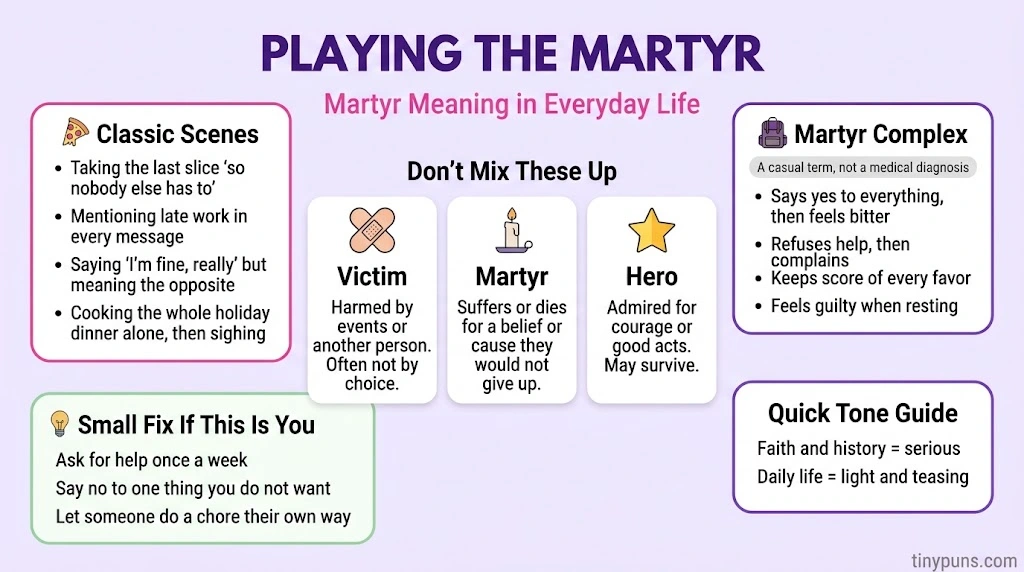
Now on to the fun. Daily English does not necessarily use the word martyr to refer to a historic event but instead to one’s habit.
The “Playing the Martyr” in this instance is someone who wants to seem to be suffering from something more than anyone else, typically some minor thing, and is keen on letting you know about it. They might not even be seeking assistance! They want you to notice the sacrifice they’ve put in.
Here are some classic scenes:
- Eating the last piece of cold pizza “so nobody else has to” then sighing for an hour after.
- Late for a group project and continually referring to it in conversation after.
- When replying “I’m fine, really”, but actually conveying the opposite message.
- Having to prepare the entire holiday meal yourself and complaining about how much work you did to do it.
All these are not crimes. We all do this, at least once or twice. It is generally teasing and never mean. However, when you hear it from a serious tone it could be a sign that people feel obliged to thank you for things that you don’t expect them to thank you for.
What is a Martyr Complex?
Additionally, people may use the term martyr complex. It is not a formal diagnosis, it is only a label. People use it to describe a pattern of persons continually burdening themselves with additional responsibilities, typically by rejecting assistance and/or by granting meaning or value to their lives through suffering.
Some of the most common signs people refer to are:
- Yes, it’s all or nothing, and then bitter.
- Refusing offers of assistance, but then complaining about going it alone.
- Tallying up all the favors.
- Guilt feelings when they rest.
If you feel this way, then you’re not broken. There are a few small changes that can help: Get assistance once a week, refuse one item you’re not really interested in and do a chore in a different manner. If it sounds weighted or persistent, consult a therapist or counselor.
Use the Martyr Meaning in a sentence.
Context determines the tone. Employ the serious sense for history, faith and every day life.
Here are some sentences that use the word martyr.
| Setting | Example Sentence | Tone |
|---|---|---|
| Faith | She is remembered as a martyr of the early church. | Serious |
| History | Many called him a martyr for free speech. | Serious |
| Family | Stop playing the martyr and let us help with the dishes. | Playful |
| Work | He made himself a martyr over one extra meeting. | Mildly critical |
| Texting | “No worries, I’ll walk home in the rain.” Ok, martyr. | Teasing |
Match the following words to their meaning and share the opposites.
Some words apply to more than one sense; choose the right word for the sense.
Synonyms (sacrificial sense): victim, sufferer, witness, saint (religious sense), person of conviction.
Alternate forms of the noun: drama queen, self-sacrificer (with a smile), long-suffering one.
Opposites: persecutor, tormentor, one who yields, one who comes out and asks for help.
Please note, that although similar in meaning, “victim” and “martyr” are not synonymous. We cover that next.
Martyr vs. Victim vs. Hero
People often confuse these three words.
A person who suffers harm from events or from another person. They didn’t have to pick it.
A martyr is one who suffers or dies for a cause or belief that he could not abandon. It is a matter of decisiveness to stand firm.
People admire a hero because of their courage or good acts. A hero may survive. A martyr is not necessarily a hero, depending on the point of view of the observer.
So that one person may be a victim and not a martyr, and a martyr and not a hero to all. The label doesn’t just describe the speaker, it describes the individual, too!
Jokes based on martyrdom and light jokes
This is Tiny Puns, so let’s keep it lighthearted and geared toward the pizza slice martyr type:
- I’m not a martyr, I just carry everything and tell everybody.
- I’m not going to say my sister is a martyr, but she certainly is one.
- Why did the dishes earn a medal? They saw one of them wash them alone and called it a sacrifice.
- Never argue with a martyr: they’ll give up gracefully and it will be a topic at dinner for 10 years.
Limit the humor to trivial affairs of daily life. The martyrs and those who mourn deserve honor.
How Do You Say Martyr?
The pronunciation is MAR-ter and the stress is on the first part. The t in the middle is soft and the ending is like “ter” not “tire.”
Other forms of martyr are martyrs (plural), martyrdom (noun), martyred (past tense), and martyring (present participle).
There are additional meanings that may appeal to you.
Interested in other terms that people search for on a regular basis? Try these:
- What does NGL mean? A brief explanation of a very common abbreviation in text-speak.
- What does the word “RSVP” stand for? A brief explanation of a phrase that every invitation includes.
- A compilation of the terms of slang usage that may make anyone’s eyes glaze over the first time they hear them.
- Why a repeating number was a popular search term was the subject of the 555. The 555 was about why a repeating number became a popular search term.
Some common misconceptions about the martyr meaning.
What is the simple martyr meaning?
A martyr is someone who suffers or dies for a belief or cause instead of giving it up. The term comes from the Greek word “martus” meaning “witness. It may also refer to a person who makes a lot of noise about the sacrifices they are making in casual speech.
What is it to be a martyr?
It involves being self-pitying, perhaps over trivial matters, and thus gaining attention and sympathy. People typically express it teasingly.
What happens to be a martyr complex?
Not a medical diagnosis, it is a casual term. It is a way of thinking that takes on more than they need, denies assistance and gains identity through sacrifice and suffering.
The word martyr is derived from what?
It’s Greek: martys = “witness”, via Latin and Old English.
What does it mean to be a martyr?
No. A victim suffers harm, frequently at an individual’s will. A martyr is someone who suffers or dies (denies) a belief or cause.
Is “martyr” a positive or negative word?
Is dependent on the speaker. It typically conveys respect in religious and historical contexts. It is lighthearted or even slightly sarcastic in everyday language.
Conclusion
The martyr meaning evolves according to the time. It is a name that people use in the context of faith and history, describing a person who had a belief to the extent that he risked his life for it, and people should use it in a serious tone. In everyday life it’s the name of the person who moans while washing the dishes, and people appreciate a smile.
If you know the context, you’re in no danger of the wrong meaning. Next time someone asks you if you want your bags carried so they don’t have to carry them, you will know how to politely refer to it.
Want to check the official definition? The Merriam-Webster entry for martyr lists every sense of the word, along with its first known use and word history.