

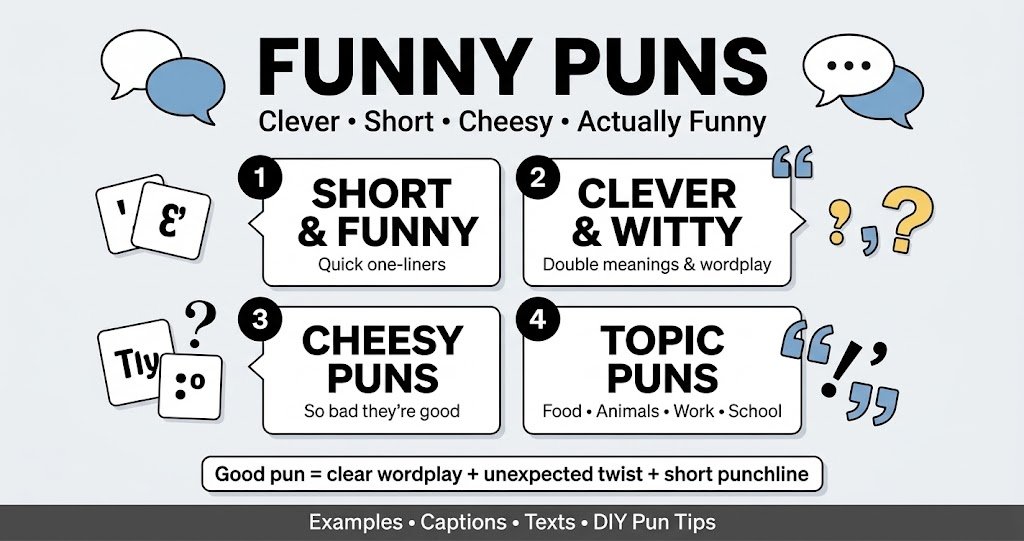
Funny puns turn ordinary words into jokes by using double meanings, similar sounds, or unexpected twists. When the wordplay lands well, even a simple sentence can become surprisingly funny.
The tricky part is finding a pun that is actually enjoyable rather than confusing, overly forced, or just another unfunny joke. Whether you need a quick one-liner, a clever pun for a conversation, or something funny for a caption, the right example depends on the kind of humor you’re looking for.
Looking for a Funny Pun That Actually Works?
You may be wondering:
- What makes a pun genuinely funny instead of just confusing?
- Where can you find short funny puns and one-liners?
- What’s the difference between a clever pun and a cheesy one?
- Which puns work best for texts, captions, or everyday conversations?
- Can you make your own funny puns without forcing the wordplay?
The sections below start with the strongest general examples, then move into short, clever, cheesy, and situation-specific puns so you can quickly find the style that fits.
The Best Funny Puns to Make You Laugh
A good pun usually works because the reader recognizes the familiar meaning first and then notices a second meaning or sound-based twist. The best examples are short enough to understand immediately, but unexpected enough to create the joke.
Here are some funny puns that rely on simple wordplay:
- I used to be a baker, but I couldn’t make enough dough.
- I wondered why the baseball kept getting bigger. Then it hit me.
- I don’t trust stairs. They’re always up to something.
- I wanted to learn how to make ice cream, but I decided to chill.
- I stayed up all night wondering where the sun went. Then it dawned on me.
- I used to hate facial hair, but then it grew on me.
- I told my suitcase there would be no vacations this year. Now it’s dealing with emotional baggage.
- I don’t want to make a chemistry joke because I might not get a reaction.
- I was going to tell a construction joke, but I’m still working on it.
- I tried to catch some fog yesterday. I mist.
These work because the punchline changes how the reader interprets the earlier part of the sentence. Words such as dough, hit, chill, dawned, and reaction carry meanings that can be understood in more than one way.
Short Funny Puns and One-Liners
Sometimes a pun doesn’t need a setup at all. A short one-liner can work better when you’re sending a quick text, replying in a group chat, or adding a small joke to a caption.
Here are some short options:
- I’m reading a book about anti-gravity. It’s impossible to put down.
- I’m friends with all electricians. We have great current connections.
- I find these jokes very re-leaf-ing.
- Don’t worry, be hoppy.
- I’m kind of a big dill.
- That’s nacho problem.
- You’re totally tea-rific.
- I’m having a grape day.
- Let’s taco ’bout it.
- Orange you glad I didn’t say banana?
- Stay pawsitive.
- Life is what you bake it.
- You feta believe it.
- I like big buns, and I cannot lie.
- Don’t go bacon my heart.
The advantage of a short pun is that the reader doesn’t have to work through a long setup. The wordplay arrives quickly, which makes these formats especially useful when the joke needs to fit into a text, caption, comment, or casual conversation.
Clever and Witty Puns
Clever puns usually depend on a little more thought. Instead of simply replacing a word with a similar-sounding one, they make the reader connect two meanings or reinterpret a familiar phrase.
For example:
- I used to be a banker, but I lost interest.
- The mathematician’s plants were growing exponentially.
- A bicycle can’t stand on its own because it is two-tired.
- The future, the present, and the past walked into a bar. It was tense.
- I got a job at a mirror factory. I could really see myself working there.
- I wondered why the musician kept carrying a ladder. He wanted to reach the high notes.
- The calendar got fired because its days were numbered.
- I opened a bakery because I kneaded the dough.
- The clock was hungry, so it went back four seconds.
- I told my friend ten jokes to make him laugh. No pun in ten did.
What separates these from a simple joke is the relationship between the two meanings. The wording creates one expectation, then the punchline makes another interpretation suddenly fit.
That small mental switch is often what gives a clever pun its payoff.
Cheesy Puns That Are So Bad They’re Good
Not every successful pun needs to be sophisticated. Some are intentionally obvious, predictable, or painfully corny—and that’s exactly why people enjoy them.
These are often called cheesy puns or dad jokes. The humor can come from the groan as much as the punchline itself.
Try these:
- What do you call cheese that isn’t yours? Nacho cheese.
- What did one wall say to the other? I’ll meet you at the corner.
- What do you call a sleeping bull? A bulldozer.
- What do you call fake spaghetti? An impasta.
- Why don’t eggs tell jokes? They might crack each other up.
- What do you call a bear with no teeth? A gummy bear.
- Why did the tomato blush? Because it saw the salad dressing.
- What do you call a fish wearing a bowtie? Sofishticated.
- Why did the scarecrow win an award? Because he was outstanding in his field.
- What did the grape say when it got stepped on? Nothing. It just let out a little wine.
The key difference is intention. A cheesy pun isn’t necessarily an unfunny joke. If the predictable wordplay is deliberate and the reader understands the joke immediately, the exaggerated corniness can become part of the humor.
That distinction matters because a pun can be technically clever but still fall flat if the wordplay is too difficult to recognize or the punchline feels forced.
Funny Puns by Topic
Sometimes you don’t just want any pun—you want one that matches the subject you’re talking about. Topic-based puns make it easier to find a joke that fits a conversation, message, presentation, classroom, or social post.
Food Puns
- I’m on a seafood diet. I see food and I eat it.
- Lettuce celebrate good times.
- Donut worry, be happy.
- I only have pies for you.
- You butter believe it.
- That’s how I roll.
- I’m feeling grate today.
- This is a pretty big dill.
Food puns work particularly well because everyday foods have plenty of words and phrases that can be turned into playful double meanings.
Animal Puns
- You’re looking pawsome today.
- Have a purr-fect day.
- I’m feline good.
- That’s im-paws-ible.
- You otter know better.
- Don’t be a chicken—take the chance.
- What a koala-ty joke.
- Stay pawsitive.
Animal puns are especially easy to understand because the wordplay usually connects a familiar animal feature, sound, or name with an ordinary phrase.
Work and Office Puns
- I’m outstanding in my field.
- I have a lot on my plate, but it’s all in good taste.
- I’m trying to make ends meet, but they’re working remotely.
- My career is going places. Mostly meetings.
- I told my boss I needed a raise. He said, “What goes up must come down.”
- I’m just trying to stay current at work.
- My job is very demanding. It keeps me occupied.
These work best when the original phrase already has a familiar meaning and the pun adds a second interpretation.
School and Study Puns
- I’m taking my studies one problem at a time.
- Math teachers have too many problems.
- I was going to make a chemistry joke, but there was no reaction.
- I’m trying to stay positive, but my grades keep subtracting from it.
- History teachers love the past because it’s present all the time.
- I have a degree of certainty that this joke is terrible.
School puns can be useful when the audience already understands the subject being referenced. A familiar academic term gives the wordplay something to build on.
Science and Math Puns
- I have a chemistry joke, but I don’t think it will get a reaction.
- Never trust an atom. They make up everything.
- Parallel lines have so much in common. It’s a shame they’ll never meet.
- I’m reading a book about gravity. It’s quite uplifting.
- The mathematician was afraid of negative numbers. He would stop at nothing to avoid them.
- I think my geometry teacher is acute.
The best science and math puns don’t require advanced knowledge. They use familiar terms in an unexpected context, so the joke remains understandable even to a casual reader.
Funny Puns for Texts, Captions and Social Posts
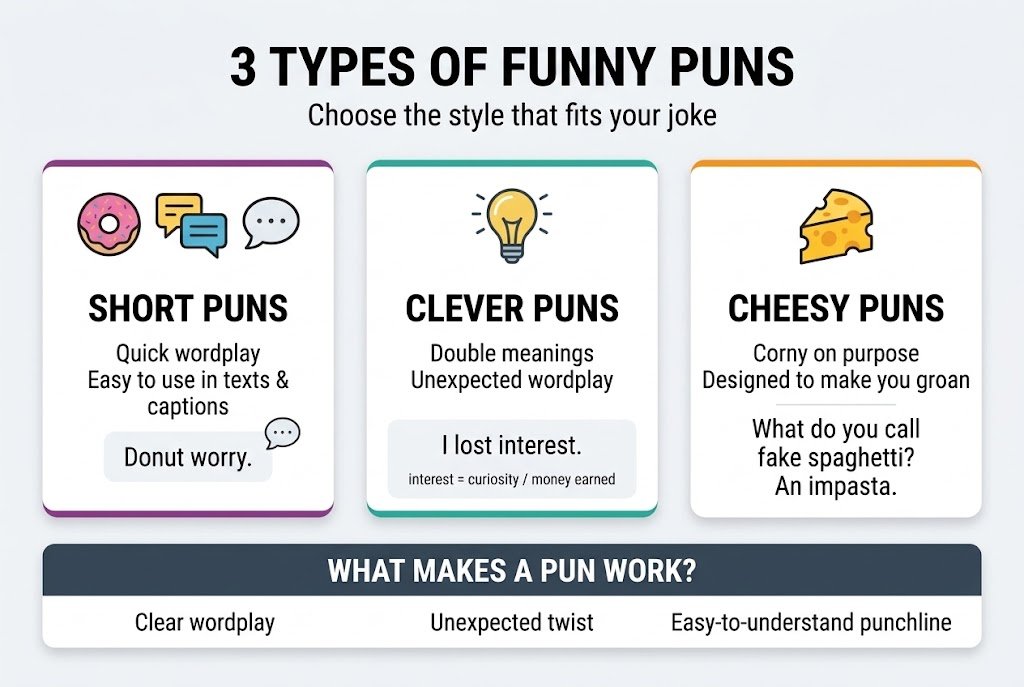
A pun that works in conversation may not work as well in a caption.
>For short-form content, the line should usually make sense without a long explanation.
Texts and Group Chats
- “I’m just here for the pun of it.”
- “That joke was un-bee-lievable.”
- “You really nailed that one.”
- “I’m having a pun-derful day.”
- “Okay, that was a little corny.”
- “I’ll stop now before this gets punbearable.”
Social Media Captions
- “Current mood: pawsitive.”
- “Good vibes and butter days.”
- “Just winging it.”
- “Having a whale of a time.”
- “Donut disturb.”
- “Feeling grape.”
For Cards and Messages
- “You’re tea-rific.”
- “You’re one in a melon.”
- “Thanks a latte for always being there.”
- “You’re simply unbe-leaf-able.”
- “I’m so glad we’re friends. It’s a big dill.”
The best choice depends on the audience. A short caption can handle a quick wordplay joke, while a personal message can support a slightly more specific pun connected to the person or occasion.
What Makes a Pun Funny—and Why Some Fall Flat
A pun doesn’t become funny simply because two words sound alike. The reader needs to recognize the connection quickly enough for the wordplay to produce a payoff.
A strong pun usually has four qualities:
- The wordplay is easy to recognize.
If readers have to decode the joke for too long, the punchline loses its impact. - The second meaning is unexpected.
The reader should understand the original phrase and then notice the alternate interpretation. - The wording is concise.
Extra words can bury a simple punchline. - The joke fits its context.
A food pun makes more sense in a conversation about food than in a completely unrelated situation.
Why can a pun feel unfunny?
A pun may fall flat when the word substitution is too forced, the connection is unclear, or the punchline has already become extremely predictable.
There’s also an important difference between a bad pun and an unfunny pun. A deliberately terrible pun can still work because the audience is expected to groan. An unfunny pun, on the other hand, may simply fail to create a clear or satisfying connection.
That’s why quality isn’t only about how clever the wordplay is. Timing, clarity, context, and surprise matter too.
How to Make Your Own Funny Pun
You don’t need to be a professional comedian to create a pun. Start with an ordinary subject and look for words that have another meaning, another pronunciation, or a familiar phrase that can be changed.
1. Choose a simple subject
Start with something easy to build around, such as food, animals, school, work, sports, or a person’s name.
2. Find words with multiple meanings
Look for words that can mean different things in different contexts.
For example, “interest” can relate to curiosity as well as money earned from an account.
3. Look for similar sounds
Homophones and near-homophones can create easy wordplay. Think about words that sound alike but have different meanings.
4. Connect the word to a familiar phrase
The familiar phrase gives the reader a starting point. The pun changes one part of it to create the surprise.
5. Keep the punchline short
Once the wordplay works, remove anything that isn’t necessary. A shorter setup usually makes the final twist easier to notice.
6. Read it as someone else would
Ask yourself whether another person would understand the second meaning without an explanation. If you have to explain the joke immediately afterward, the wording may need another revision.
A useful formula is:
familiar phrase + unexpected word meaning = potential pun
For example, take a familiar phrase and replace one important word with a related term that creates a second meaning. The closer the final wording feels to the original phrase, the easier it is for the reader to catch the joke.
FAQ About Funny Puns
What is the difference between a pun and a joke?
A pun is a type of wordplay that creates humor through multiple meanings, similar sounds, or clever changes to familiar expressions. A joke can use many other techniques, including storytelling, exaggeration, surprise, or observation. In other words, a pun can be a joke, but not every joke is a pun.
Are puns supposed to be funny or cheesy?
They can be either. Some puns aim for clever wordplay, while others intentionally use obvious or predictable jokes. Cheesy puns often work because the audience knows they’re corny and enjoys the exaggerated simplicity. The important factor is whether the wordplay fits the intended audience and situation.
What makes a good pun?
A good pun usually combines clear wordplay with an unexpected second meaning. It should be easy enough to understand without a long explanation and short enough that the punchline doesn’t get buried. Context also matters: a pun becomes more effective when the subject and wording naturally fit together.
Can a pun be unintentional?
Yes. People sometimes create accidental puns when a word or phrase has two possible meanings. These are often noticed after the sentence is spoken or written. An unintentional pun can still be funny, especially when the alternate meaning creates an unexpected interpretation.
How do you come up with a funny pun?
Start with a simple topic, then list words connected with it. Look for words with multiple meanings, similar sounds, or connections to familiar expressions. Build a short sentence around the strongest possibility and remove unnecessary words. Finally, test whether someone else can understand the wordplay without needing an explanation.
The Bottom Line
Funny puns work best when the wordplay is quick to recognize, the second meaning creates a surprise, and the joke fits the situation. Some are clever, some are deliberately cheesy, and others are simply short one-liners that get a quick laugh.
If you’re choosing a pun for a text, caption, conversation, or message, start with the audience and situation, then choose the style that fits. And if none of the existing examples feels right, use the same simple process—find a double meaning, connect it to a familiar phrase, and keep the punchline short—to create your own.